Almond Eyes: 7 Signs, Photo Test, and Shape Comparisons
A practical guide to almond shaped eyes: the visible traits that matter, the photo test that reduces confusion, and how almond eyes differ from round, hooded, upturned, and downturned eye shapes.
The quick answer
If you want the short version, almond eyes usually look more elongated than round, softly tapered at the inner and outer corners, and balanced rather than overly open or overly narrow. One of the most practical public-facing checks is this: when you look straight ahead in a relaxed expression, the iris often touches the upper and lower lids with very little white showing above or below it.
If you want the fastest check, look straight ahead with a relaxed face. Almond shaped eyes usually look longer than they are tall, taper softly at both corners, and have the iris lightly covered by the upper and lower lids. If you can clearly see white above or below the iris, round eyes may be a stronger match.
That said, no single clue should carry the whole decision. Eye shape looks different when you smile, raise your brows, wear winged liner, curl your lashes, tilt your chin, or take a close selfie with a wide phone lens. The most reliable way to decide whether you have almond eyes is to study three things together: the outline of the eye opening, the amount of white visible around the iris, and the direction of the outer corners.
The reason this topic creates so much confusion online is that people often mix shape labels with lid or spacing labels. Almond describes the overall outline. Hooded describes how much of the crease is covered. Upturned describes the corner angle. Close-set and wide-set describe spacing across the face. Once you separate those categories, eye-shape identification becomes much calmer and much more accurate.
A useful tie-breaker for the query "almond eyes" is to avoid treating it as only a beauty phrase. In this guide, almond eyes means an eye opening that is horizontally balanced, gently tapered, and usually less vertically open than round eyes.
The signature traits of almond eyes
There is a reason almond eyes are so often described as balanced. In plain language, they tend to look streamlined. The eye opening usually appears longer than it is tall, the corners taper gently instead of ending in a dramatic round curve, and the iris sits neatly within the lid line. Even before you reach for technical terms, the overall impression is one of smooth proportion.
What matters, though, is not whether your eyes fit a glamorous beauty label. What matters is whether the visible structure of your eyes actually matches the description. A useful guide should help you notice shape without turning your face into a verdict. That is especially important because many people reasonably have more than one valid eye trait at the same time, such as almond and hooded, or almond and slightly upturned.
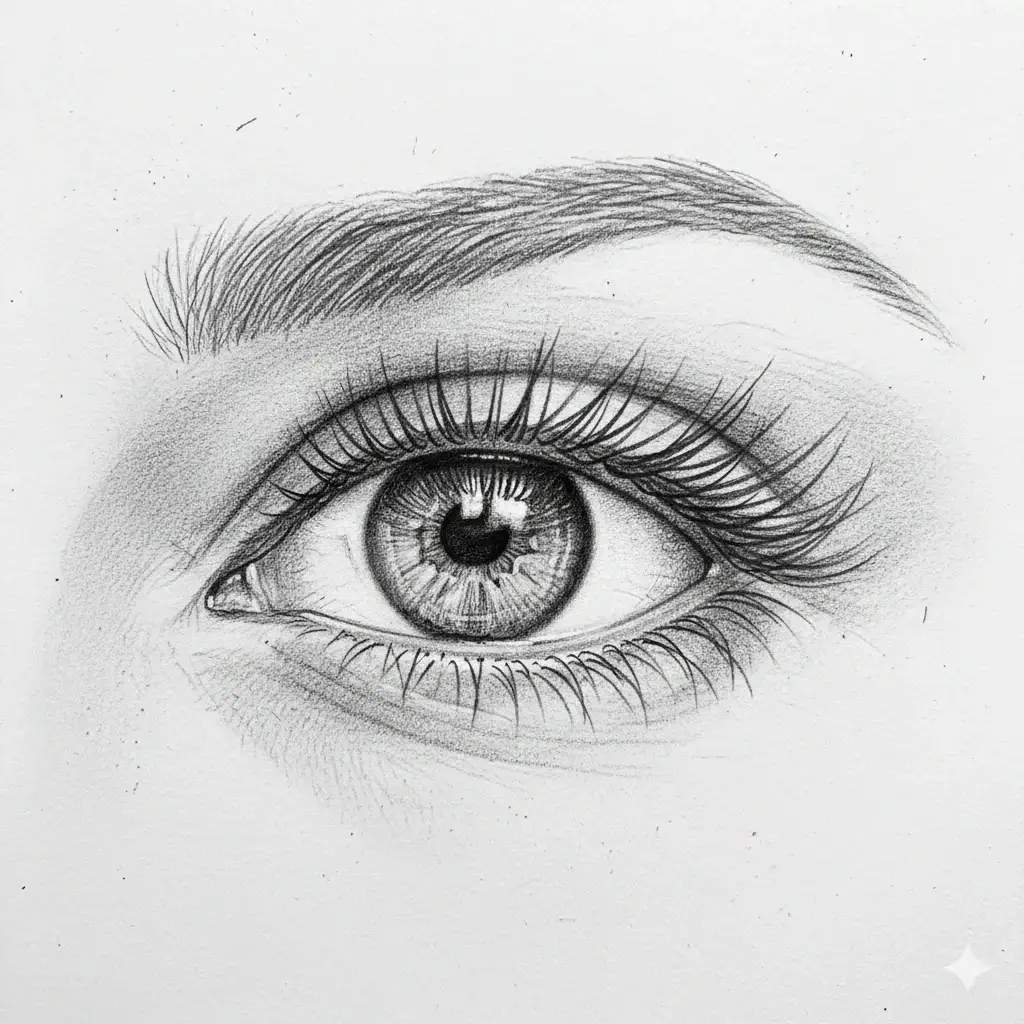
1. The outline looks elongated, not circular
Almond eyes tend to read horizontally first. In other words, your eye opening feels longer and more tapered than it feels wide or round. This is one of the easiest visual clues to spot in a neutral, straight-on photo.
- The eye usually looks longer than it is tall.
- The corners taper softly instead of appearing blunt or doll-like.
- The shape still reads elongated even without eyeliner.
2. The iris touches the upper and lower lids
A practical self-check used in many public guides is to look at the iris when your face is relaxed and you are looking straight ahead. If the iris touches the top and bottom lids, almond eyes become more likely. If you see clear white above or below the iris, round eyes may be a better fit.
- Use a neutral expression rather than a surprised one.
- Check both eyes because asymmetry is normal.
- Do not rely on one heavily edited selfie.
3. The corners look gently tapered
Almond eyes do not usually end in a blunt circle. The inner and outer corners tend to narrow more delicately, which helps create that smooth, elegant outline people often associate with the shape.
- The taper can be subtle rather than dramatic.
- A little winged liner can exaggerate taper, so compare with a bare-eye photo too.
- The outer corner may be neutral, slightly upturned, or slightly downturned.
4. The eye reads balanced in a relaxed face
Many eye-shape mistakes come from reading expression instead of structure. Almond eyes often become easiest to identify when your brows are relaxed, your jaw is calm, and your gaze is straight ahead rather than lifted toward the camera.
- Raised brows can make almost any eye look rounder.
- Smiling can squeeze the lower lid upward and change the apparent shape.
- A neutral expression tells the truth better than a posed one.
5. The eye still looks almond-shaped without styling
Almond eye shape should remain visible in a plain, front-facing photo. Makeup can emphasize it, but the basic horizontal outline and tapered corners should not depend entirely on eyeliner, lashes, or photo editing.
- Compare a natural photo with a styled photo.
- If styling creates the shape alone, the natural shape may be round or mixed.
- Use the detector as a second opinion when the mirror check is uncertain.
A mirror test and selfie check that actually works
The best eye-shape check is wonderfully ordinary: a mirror, a front-facing photo, decent daylight, and a little patience. You do not need a ring light, a contour routine, or a dramatic close-up to decide whether your eyes are almond-shaped. In fact, the more production you add, the easier it becomes to misread the features you are trying to study.
If you have ever gone from 'I think I have almond eyes' to 'Now I think they are round, maybe hooded, maybe upturned, maybe all of the above' after ten minutes on your camera roll, you are not alone. The trick is to assess one feature at a time and in the right order.
Start with a straight-on photo at eye level
Choose a photo where your face is turned directly toward the camera and the lens is not dramatically above or below you. Natural window light is ideal because it shows the lid line and iris clearly without creating harsh shadows.
- Avoid beauty filters and portrait blur.
- If possible, compare a mirror check with a photo taken from arm's length rather than very close to the face.
- A calm expression is more useful than a performance smile.
Look at the eye opening before you look at the crease
Many people begin by asking whether they have hooded eyes, but if your goal is to identify almond shape, first study the opening itself. Ask whether it feels elongated and tapered or open and circular. This single distinction often removes half the confusion right away.
- If the eye feels longer than taller, almond becomes more likely.
- If the eye feels visibly round and open, round may be a better fit.
- Take note of how the corners narrow at the ends.
Check the iris-to-lid relationship
Now focus on where the iris sits. In almond eyes, the iris often meets the upper and lower lids, creating a contained and tidy look. In round eyes, you may notice more white of the eye above or below the iris when looking straight ahead.
- Do this check with your face fully relaxed.
- Repeat it in more than one photo so one awkward angle does not fool you.
- A little asymmetry between the two eyes is ordinary and should not derail the whole conclusion.
Compare the outer corner to the inner corner
This is how you separate almond from upturned or downturned. Draw an imaginary line straight through the inner corner. If the outer corner sits above it, the eye reads as upturned. If it sits below it, it reads as downturned. That angle can coexist with an almond outline rather than replacing it.
- Upturned is about angle, not overall shape.
- You can absolutely have almond eyes that are also slightly upturned.
- Do not confuse a lifted eyeliner flick with a naturally lifted outer corner.
Only after that, check for hooding or spacing
Once you know whether the core outline is almond-like, then look for secondary traits. Is the crease partly hidden by extra upper-lid skin? Then the eyes may be hooded as well. Is the distance between the eyes narrower or wider than one eye width? Then spacing is part of the visual description too.
- Hooded refers to lid coverage, not the whole outline.
- Close-set and wide-set are spacing traits, not replacements for almond or round.
- A layered label like hooded almond eyes can be perfectly accurate.
Almond vs round vs upturned: the simplest side-by-side check
The table below is designed for real-world confusion. It focuses on the three labels readers most often mix together when they are looking at selfies, trying eyeliner styles, or wondering why one makeup tutorial flatters their friend but not them.
| Feature | Almond eyes | Round or upturned eyes | What to check in your own photo |
|---|---|---|---|
| Overall outline | Elongated and softly tapered. | Round eyes look more circular. Upturned eyes may still be almond or round, but the outer corner lifts. | Ask whether the first impression is horizontal balance or vertical openness. |
| Iris visibility | The iris often touches the upper and lower lids. | Round eyes often show more white above or below the iris. | Use a neutral expression and look straight ahead rather than upward. |
| Outer corner | May be level, slightly lifted, or slightly lowered. | Upturned eyes place the outer corner visibly above the inner corner. | Imagine a straight line through the inner corner and compare the outer edge. |
| Most common mistake | Mistaken for round eyes in wide, expressive selfies. | Upturned eyes are often mistaken for almond eyes because both can feel sleek. | Check multiple photos, especially one taken when your face is calm. |
| Best tie-breaker | Taper and iris contact are the strongest clues. | Round relies on openness. Upturned relies on corner angle. | Separate outline, iris visibility, and angle instead of forcing one label to do all the work. |
| Almond vs round eyes | More horizontal, tapered, and contained around the iris. | Round eyes look taller and often show more white above or below the iris. | Relax your face and ask whether the eye reads like a long oval or an open circle. |
| Almond upturned eyes | Almond describes the outline; upturned describes the outer-corner angle. | Upturned almond eyes have both a tapered outline and a lifted outer corner. | Check taper first, then compare the outer corner to the inner corner. |
Important nuance: almond and upturned are not mutually exclusive. A person can have almond eyes with a slight upward tilt at the outer corners.
Photo mistakes that distort eye shape
The internet has trained us to trust the camera as if it were neutral, but it is not. Phone lenses stretch nearby features, front cameras warp proportions at very short distance, and expression can change the apparent geometry of the eye in a fraction of a second. If you are trying to identify almond eyes from a photo, technique matters much more than most people expect.
This is also where a lot of unnecessary insecurity begins. Someone looks at one distorted selfie, decides their eye shape changed overnight, and starts treating ordinary anatomy as a mystery. The kinder and more accurate approach is to assume the image may be misleading until a second or third clean reference supports it.
| Photo factor | How it can mislead you | Better practice |
|---|---|---|
| Raised brows | Makes the lid space look larger and can make almond eyes appear rounder. | Relax the forehead and compare with a neutral mirror view. |
| Big smile | Pushes the lower lid upward and changes how much iris shows. | Take at least one photo with a calm mouth and natural gaze. |
| Winged liner | Can visually stretch or lift the outer corner, exaggerating almond or upturned traits. | Check a bare-eye photo or one with very light makeup. |
| False lashes or heavy mascara | Can hide the real lid line and alter the impression of openness. | Compare with a makeup-free photo in daylight. |
| Phone too close to the face | Wide-angle distortion can change proportions and make the eye area read differently. | Step back and crop later instead of shooting from extremely close range. |
| Head tilt | Can fake an upturned or downturned look that is really just posture. | Keep your head level and align the camera at eye height. |
Can you have hooded almond eyes? Yes, and that is where many people get stuck
One of the biggest reasons people second-guess themselves is that they assume eye labels should behave like exclusive boxes. Real faces are not that tidy. A person can have an almond outline and a hooded lid. Another person can have almond eyes that are slightly downturned. Someone else can have almond eyes plus close-set spacing. None of those combinations are contradictions.
This is the key logic that makes eye-shape content more accurate and more emotionally useful. When a guide forces readers into one dramatic label, it usually makes them feel more confused. When a guide explains that outline, corner angle, lid coverage, and spacing are related but separate observations, readers finally have language that matches what they actually see.
For styling, this matters too. If you have hooded almond eyes, your eyeliner decisions may be influenced by hooding while your general eye proportions still read almond. If your almond eyes are also slightly upturned, a classic wing may echo the natural lift beautifully. If they are almond but downturned, lifting the outer third softly can create balance without pretending the natural shape is wrong.
Two newer search patterns are worth separating carefully: thin almond eyes and upturned almond eyes. Thin almond eyes usually keep the tapered almond outline but have less vertical lid opening, while upturned almond eyes combine that almond outline with a visibly lifted outer corner. Both can belong on this page as supporting distinctions, but they should not replace the main almond-eye definition.
Almond + hooded
The eye opening is elongated, but the crease is partly hidden when the eye is open. Many people with this combination mistake hooding for a different main shape.
Almond + upturned
The outline is tapered and balanced, while the outer corner sits slightly higher than the inner corner. This mix often creates a sleek, lifted look.
Almond + close-set
The eye itself reads almond, but the distance between the eyes is tighter than one eye width. Spacing changes styling decisions without changing the core outline.
Almond + thin or narrow
The opening still looks tapered and longer than it is tall, but the visible vertical space is smaller. Check iris contact and corner taper before assuming the eye is simply small.
Almond + round influence
Some eyes sit between almond and round. If the corners taper but the center opens widely, compare bare-eye photos before choosing one label.
When an AI eye-shape detector can help
A good detector tool does not replace your own observation; it supports it. The most helpful use case is when your eyes sit between categories or carry more than one trait at once. That is where readers often bounce between almond, hooded, round, and upturned without feeling fully convinced by any single label.
An AI workflow is especially useful when it examines multiple visible cues together instead of treating eye shape like a one-question quiz. In practical terms, that means looking at lid visibility, eye opening, iris exposure, corner angle, and spacing at the same time. A multi-feature approach is usually more grounded than relying on just one dramatic clue from one dramatic selfie.
The best result comes when you pair tool output with clean inputs. Use a straight-on, front-facing photo, keep your expression neutral, and avoid strong beauty filters. If the result suggests a layered answer such as hooded almond eyes or almond eyes with a slight upward tilt, that is often a sign the analysis is paying attention to real overlap rather than forcing a neat but inaccurate label.
Want a second opinion after the mirror test?
Use our detector with a clear front-facing photo, then compare the result with the traits and table above. The combination of self-check plus photo analysis usually gives readers the most confidence.
Editorial standards and how this page supports EEAT
For a beauty-adjacent guide like this one, experience, expertise, authoritativeness, and trust are less about sounding clinical and more about being careful, transparent, and genuinely useful. We built this page to help readers identify visible traits with confidence while avoiding the two common traps in eye-shape content: overstating certainty and turning anatomy into a beauty hierarchy.
Our approach follows practical EEAT principles such as source awareness, scope discipline, and honest limitation-setting. If you want a general overview of how these standards shape content quality, Semrush has a readable explainer on EEAT.
Just as importantly, we keep the scope of the article narrow. This page is about visual identification of almond eyes in everyday photos and mirrors. It is not a medical resource, it is not a diagnostic guide, and it does not claim that one eye type is more attractive, more feminine, or more correct than another.
- We describe visible eye traits in plain English and avoid hype-driven claims.
- We acknowledge overlap between shape, lid, angle, and spacing instead of forcing one rigid label.
- We cite one anatomy-adjacent research source for background context and one trust-guidance source for editorial framing.
- We explain where photos can mislead readers so the page stays accurate in real use, not only in theory.
- We present eye-shape identification as descriptive guidance for styling and self-understanding, not as a measure of beauty or value.
Frequently asked questions
Look for an elongated eye opening with softly tapered corners and check whether the iris touches the upper and lower lids when you look straight ahead in a relaxed expression. Then confirm that the eye reads balanced rather than very open and circular.
Almond eyes are not considered exceptionally rare, and there is no reliable universal percentage because eye-shape labels are visual categories rather than standardized medical measurements. Their appearance varies across populations and can overlap with hooded, upturned, downturned, thin, or close-set traits.
No. Almond describes the overall outline of the eye, while upturned describes the angle of the outer corner. A person can have almond eyes that are also slightly upturned, so the terms can overlap without meaning the same thing.
Yes. Hooded refers to lid coverage and crease visibility, while almond refers to the shape of the eye opening. That combination is common and is one reason people often feel confused when they try to choose only one label.
Usually less than round eyes do. In many almond-eye descriptions, the iris touches the top and bottom lids or comes very close to doing so. If you clearly see white above or below the iris in a neutral expression, round eyes may be more likely.
Yes. Winged liner, outer-corner shadow, lifted lashes, and certain photo angles can make round eyes appear longer and more tapered than they naturally are. That is why it helps to compare with a bare-eye or light-makeup photo.
A detector can provide a strong second opinion when the photo is clear, front-facing, and neutral. It is most useful when your eyes have overlapping traits, such as almond plus hooded or almond plus slightly upturned.
The main characteristics of almond eyes are an elongated opening, softly tapered corners, iris contact with the upper and lower lids, and a balanced look that is less vertically open than round eyes.
Almond eyes are eyes that look horizontally elongated, taper softly at the inner and outer corners, and usually have the iris touching or being slightly covered by both the upper and lower eyelids.
Yes, they can be. Thin almond eyes usually keep the elongated, tapered outline of almond eyes but show less vertical openness. Judge the outline, iris contact, and corner taper together instead of relying only on size.
Upturned almond eyes combine two traits: the eye opening is almond-shaped, and the outer corner sits slightly higher than the inner corner. Almond describes outline, while upturned describes angle.
References and further reading
We kept the source list short and intentional. One link supports editorial quality standards, one supports anatomy-adjacent background context, and the internal links help readers continue the identification process on-site.