Eye Separation Ratio: How to Measure Eye Spacing
A practical guide to the gap between your eyes: measure it consistently, understand the ratio, and keep spacing separate from eye shape, makeup advice, and medical diagnosis.
The quick answer
Eye separation ratio is a way to describe the space between the inner corners of the eyes in relation to a reference width. In a simple beauty-photo check, that reference may be the visible width of one eye. A more technical version can compare the gap with a broader facial width. The point is consistency: measure the same landmarks in the same kind of image rather than trusting a close selfie or a posed expression.
To estimate your eye spacing, use a straight-on photo taken at eye level with a relaxed face. Mark the inner-corner gap, measure the width of one eye, then divide the gap by that reference width. The result is a descriptive ratio, not a pass-or-fail score. A gap that looks smaller than one eye width may read as close-set; a gap around one eye width may look balanced; a larger gap may read as wide-set.
The most important boundary is that spacing is only one layer of appearance. Eye shape describes the outline, hooding describes lid coverage, and upturned or downturned describes corner angle. Someone can have almond eyes with close-set spacing, hooded eyes with wide-set spacing, or a combination that does not fit a single label.
What eye separation ratio means
The phrase eye separation ratio sounds more exact than it usually is in beauty content. There is no single universal formula used by every guide, app, or researcher. One page may compare the inner-corner gap with one eye width. Another may compare a landmark-to-landmark distance with facial width. That is why a useful guide should name the landmarks and the denominator instead of presenting one number as a verdict.
For an everyday photo check, use the inner canthi, or the points where the upper and lower lids meet near the nose, as the endpoints of the central gap. Then choose one reference and keep it stable. If you use one eye width, measure the widest visible horizontal span of the same eye. If you use facial width, state which outer landmarks you used. Do not mix a close-up crop, a mirrored image, and a full-face image and expect the ratios to agree.
This also explains why eye separation ratio is related to, but not identical with, pupillary distance. Pupillary distance is usually used for optical fitting and refers to the relationship between the pupils. Eye-spacing descriptions in a beauty guide focus on visible inner-corner spacing and overall facial balance. They can be discussed together, but they answer different practical questions.
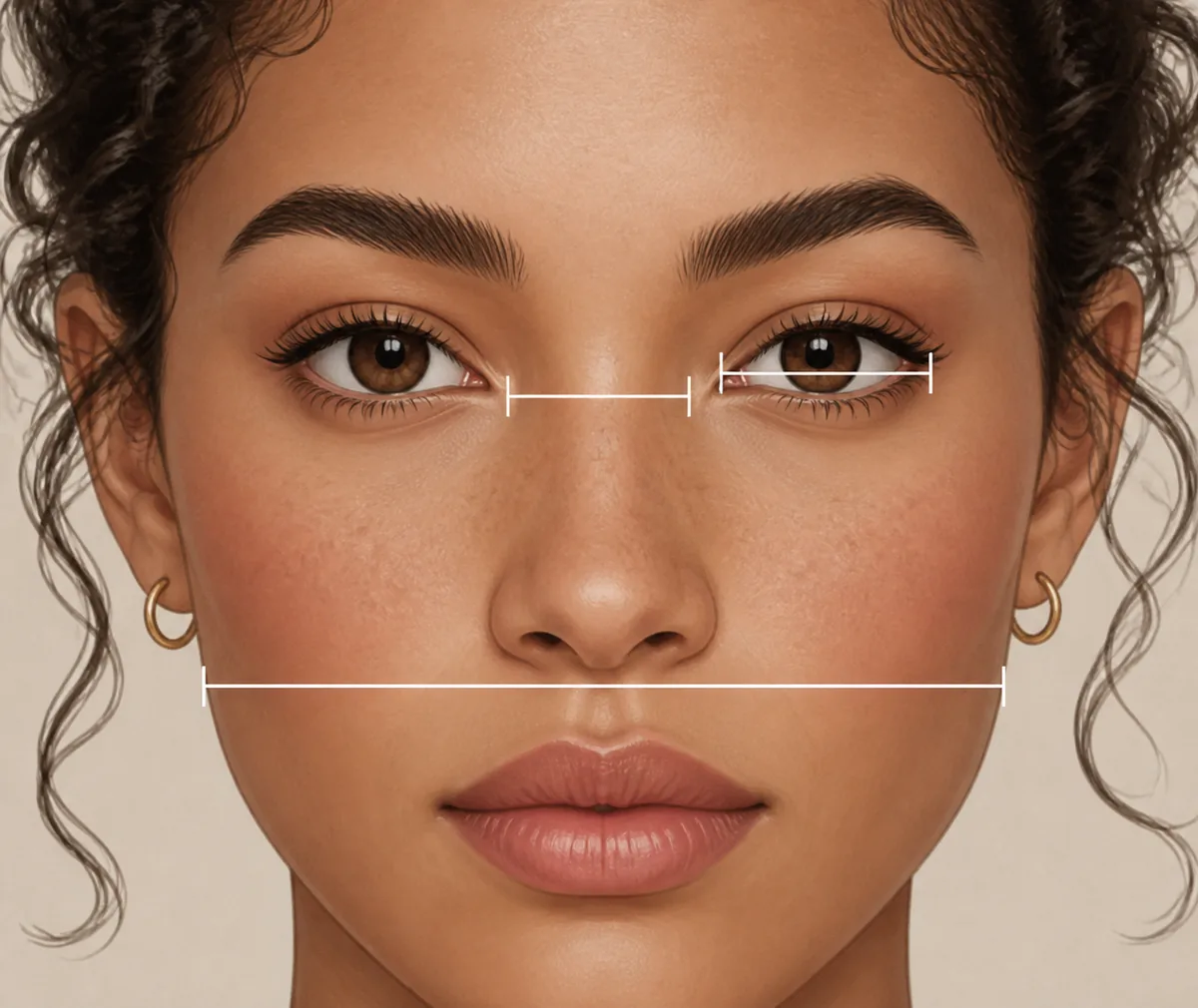
The measurements that matter
Before calculating anything, identify the three parts of the measurement. A consistent photo and clear landmarks are more useful than a false impression of precision.
1. Inner-corner gap
Measure from the inner corner of one eye to the inner corner of the other. Keep the line level with the eyes and avoid following the slope of the nose.
2. One-eye reference
Use the visible horizontal width of one eye when you want a simple close-set, balanced, or wide-set comparison. Measure one eye rather than adding both eye widths together.
3. Facial-width reference
A broader ratio can compare the central gap with a declared face-width span. It is more sensitive to crop, head angle, and landmark choice, so it should be treated as a description rather than a beauty score.
4. Landmark quality
If the corners are hidden by lashes, eyeliner, hair, shadow, or a turned head, the result is an estimate with a wide margin of error. A cleaner image is more valuable than more decimal places.
How to measure eye separation ratio from a photo
The safest way to measure eye spacing is to make the image boring. Use a neutral expression, remove strong filters, hold the camera at eye level, and step back far enough that the phone is not very close to the face. You can crop the photo afterward. This reduces the wide-angle stretching that makes the central gap look different from one selfie to another.
You do not need a medical ruler or a perfect facial landmark system for a useful beauty comparison. The goal is to repeat the same simple method twice and see whether the interpretation stays stable. If two clean photos disagree dramatically, treat the measurement as unreliable instead of choosing the result you prefer.
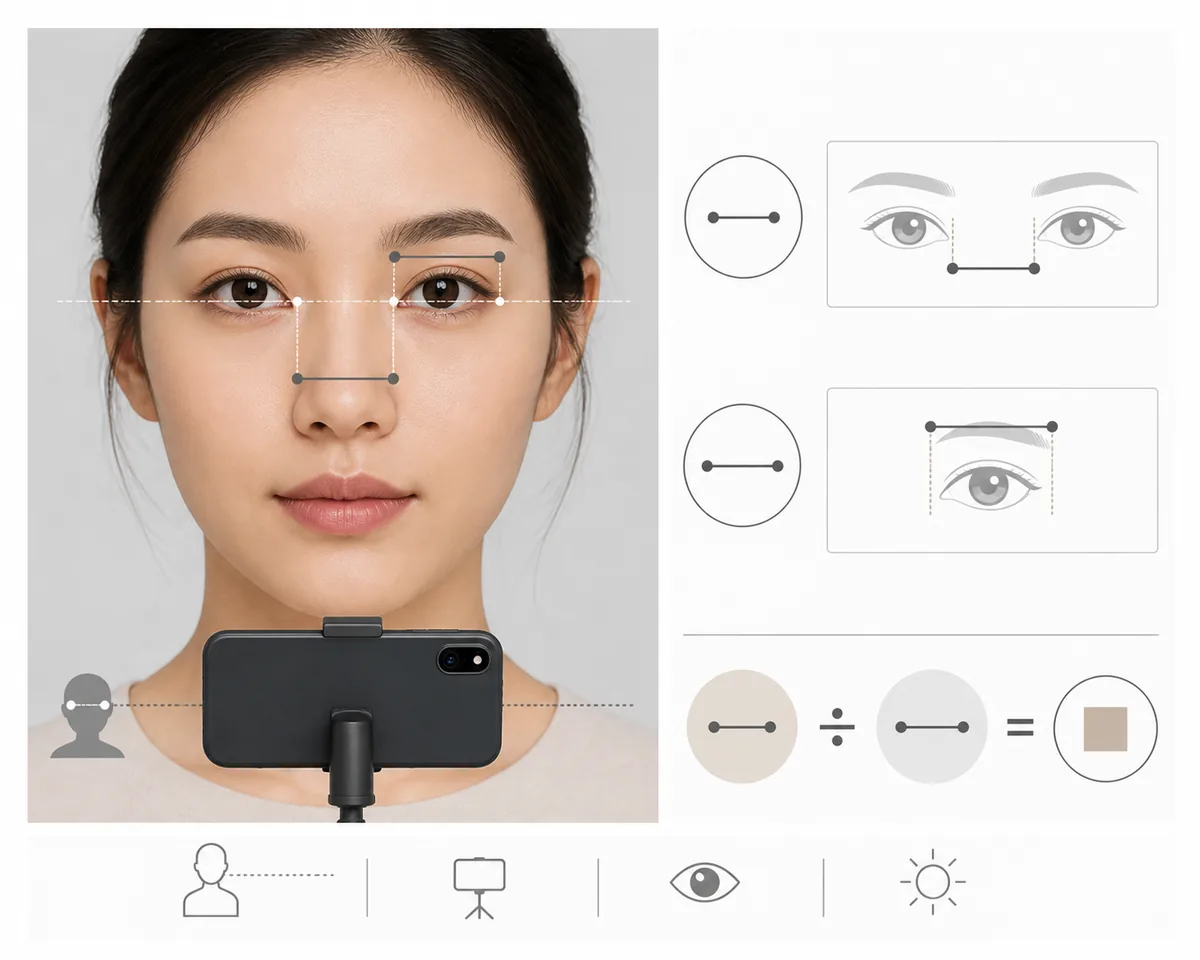
Choose a neutral, straight-on reference
Pick a front-facing photo with the camera close to eye level. Relax your eyebrows, keep your head level, and avoid a smile that pushes the lower lids upward.
- Use daylight or even indoor light.
- Avoid portrait blur, beauty filters, and extreme close-ups.
- Keep both eyes visible and do not use a tilted head as the only reference.
Mark the inner corners
Identify the inner corner of each eye where the lid edges meet near the nose. Draw an imaginary horizontal line between them. Do not measure from the pupils or from the outer corners when your goal is the visible central gap.
- Use the same landmark on both sides.
- If makeup hides the corner, switch to a bare or lighter-makeup photo.
- Small left-right asymmetry is normal; record both sides only if the difference is obvious.
Measure one eye width
Measure the horizontal distance from the inner corner to the outer corner of one eye. Use the eye that is clearest, then repeat with the other eye if the photo is symmetrical enough. This is the denominator for the simple one-eye-width ratio.
- Do not measure the eyebrow or the eyelid crease.
- Keep the measurement line level with the eye opening.
- Use the same scale for the gap and the reference width.
Calculate and label the method
Divide the inner-corner gap by the chosen reference width. For example, a 30-pixel gap divided by a 60-pixel eye width produces 0.50 in that image. Write down the method next to the number so a different denominator is not mistaken for a different face.
- A ratio of 0.50 is an example, not a universal ideal.
- Round sensibly; two decimal places are usually enough for a photo estimate.
- Repeat the measurement on a second clean photo before drawing a conclusion.
Compare the result with the visual impression
Use the number to support what you can already see, not to override it. If the image reads as close-set but the ratio is near one eye width, check the crop, camera distance, and landmarks before deciding the label is wrong.
- Describe the spacing as a tendency, not a fixed identity.
- Keep eye shape, lid type, and corner angle as separate observations.
- Use the homepage detector only as a second opinion when the photo is clear.
How to read the ratio without overinterpreting it
The table is a practical visual guide, not a diagnostic reference range. The same ratio can look different when the photo, facial width, eye shape, or lens changes.
| What you compare | What it may suggest | What it does not prove | Better way to check |
|---|---|---|---|
| Gap smaller than one eye width | May read as close-set spacing. | It does not mean the eyes are narrow, unhealthy, or less attractive. | Repeat with a straight-on photo and compare with the close-set guide. |
| Gap close to one eye width | May read as balanced spacing. | It is not a required beauty proportion and does not define the eye shape. | Check whether the same impression holds across two relaxed photos. |
| Gap larger than one eye width | May read as wide-set spacing. | It does not prove a medical condition or tell you whether the eyes are almond, round, or hooded. | Compare with the wide-set guide while keeping the face scale consistent. |
| A ratio that changes by photo | Usually signals measurement noise. | It does not mean your anatomy changed between selfies. | Move the camera farther away, level the head, and remove filters or strong angles. |
Eye spacing is not the same as eye shape
This is the distinction that prevents the most confusion. Spacing describes where the eyes sit across the face. Shape describes the outline of each eye opening. Lid type describes crease visibility or coverage. Corner direction describes whether the outer corner appears lifted or lowered. These traits can overlap without cancelling one another.
If a ratio suggests close-set or wide-set spacing, use it as a placement clue for makeup or eyewear rather than a label you must defend. Outer-corner emphasis may change the visual balance of close-set eyes, while a little more attention near the inner corner may balance wide-set spacing. Those are styling choices, not corrections to a flaw.
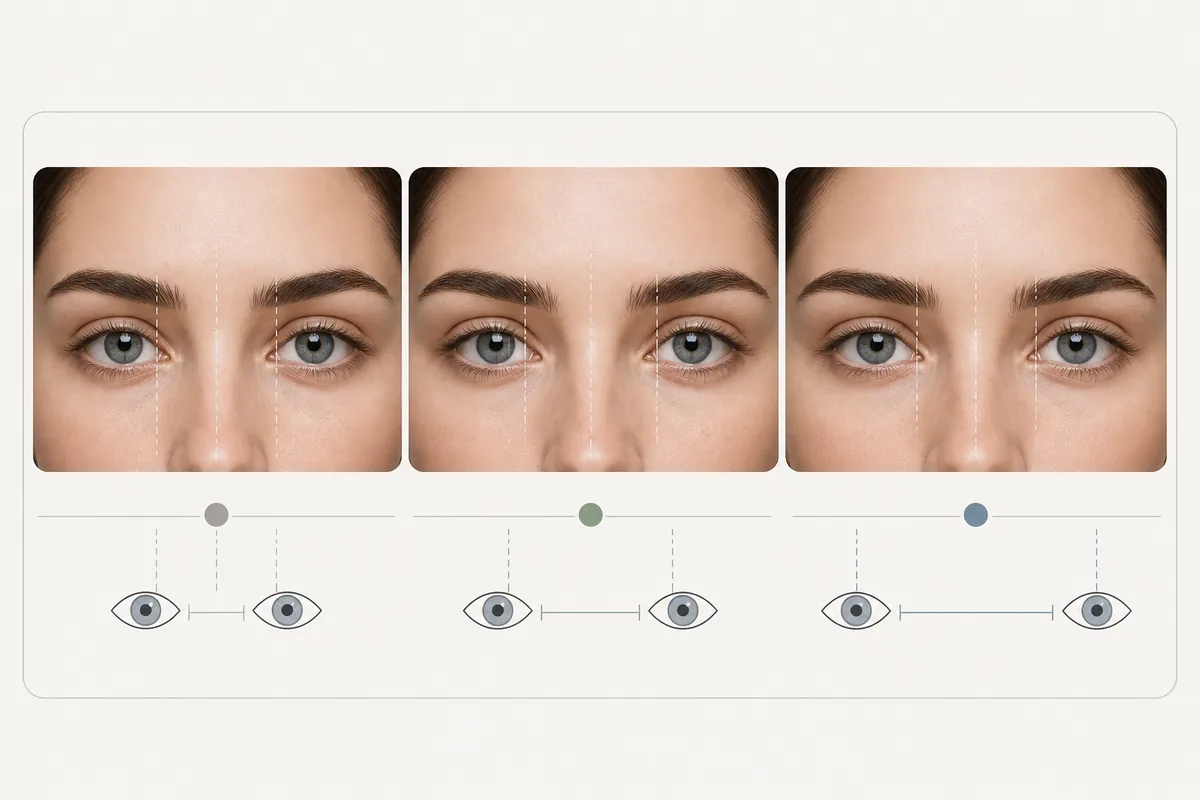
Link spacing to the right guide
- Read the Eye Shape Chart for outline, lid, corner, and spacing layers.
- Compare close-set and wide-set pages using the same one-eye-width reference.
- Do not use an almond, hooded, or round guide to answer a spacing-only question.
Keep the advice practical
- Place eyeliner or shadow according to the look you want, not a rigid ratio target.
- Treat glasses fit as an optical and comfort question, not a beauty score.
- If a sudden physical change or symptom concerns you, stop measuring and seek professional advice.
Photo errors and important limits
A phone camera is not a neutral measuring instrument. A wide lens close to the face can enlarge the center of the image, while a head turn changes the apparent distance between the two inner corners. A raised brow can open the lid, a smile can push the lower lid upward, and eyeliner can hide the exact landmark you wanted to measure. These effects are why a ratio should be repeatable before it is treated as useful.
The phrase normal eye spacing is also easy to misuse. There is a broad range of natural facial proportions, and a beauty article should not turn one-eye-width language into a universal standard. Ratio values from a photo can describe a visual impression, but they cannot diagnose hypertelorism, strabismus, or any other medical condition. They also cannot establish how a person should feel about their face.
If spacing seems to change suddenly, is accompanied by double vision, pain, swelling, new drooping, or another symptom, do not troubleshoot the issue with a selfie ratio. Contact a qualified medical professional. For eyewear fitting, use the appropriate optical measurement rather than an image-based beauty estimate.
When an AI eye-shape detector helps
An AI eye-shape detector can be useful when your photo shows mixed traits and you want a second description. It may help separate a primary outline, such as almond or round, from a spacing trait such as close-set or wide-set. That is a different job from calculating one ratio by hand, so the two methods can complement each other.
Use the result as a starting point. Upload a clear, front-facing photo, compare the explanation with the mirror check, and remember that lighting, expression, makeup, lens distance, and image quality can influence any automated estimate.
Compare your photo with the detector
Use the free Eye Shape Detector for a second opinion, then read the eye-shape chart to understand which traits are about spacing and which are about outline or eyelid structure.
FAQ
No. A ratio depends on the landmarks and denominator you choose, and natural facial proportions vary. Use a named method to describe a photo, not to rank a face.
Use a level, front-facing photo, measure the inner-corner gap, measure one eye width, divide the first value by the second, and repeat on another clean photo. Keep the camera distance and scale consistent.
Not usually. Pupillary distance is an optical measurement related to pupil centers, while an eye-spacing ratio in a beauty guide usually describes the visible inner-corner gap in relation to a declared reference width.
There is no universal good ratio. The useful question is whether the measurement is repeatable and whether it helps you describe close-set, balanced, or wide-set spacing without turning a natural difference into a problem.
Yes. Almond describes the outline of the eye opening, while close-set describes the distance between the eyes. They are separate layers and can accurately describe the same face.
Camera distance, lens distortion, head angle, expression, makeup, crop, and landmark visibility can all change the apparent ratio. Use a neutral photo taken farther from the face and compare more than one image.
References and further reading
These references support the distinction between a photo-based beauty description and optical or clinical measurements. The article’s ratio example is an educational method, not a medical threshold.