Eye Shape Chart: 8 Eye Types Explained and How to Tell Yours
A practical, photo-friendly guide to identifying almond, round, hooded, monolid, upturned, downturned, close-set, and wide-set eyes without turning a simple mirror check into a guessing game.

The quick answer
If you want the short version, your eye shape is usually identified by looking at four visible traits together: whether you have a crease, how much lid space shows when your eyes are open, whether the outer corners sit higher or lower than the inner corners, and how much white of the eye is visible around the iris.
Most people do not fit neatly into one dramatic label. Instead, they often have a primary eye shape plus a secondary trait. For example, someone can have almond eyes that are also hooded, or round eyes that are also slightly downturned. That overlap is one reason eye shape conversations feel confusing online: people are often using one term for shape and another for spacing or lid structure.
A good eye shape chart should help you compare features calmly, not pressure you into picking a glamorous category. The goal is simple: understand what you are seeing in your own photo or mirror so you can describe it clearly, style it confidently, and use a detector tool more effectively.
Eye shape chart
Use this chart as your first pass. It is designed for real people taking selfies in ordinary lighting, not for perfect studio portraits. Read across the row that feels closest to your features, then confirm with the self-check steps below.
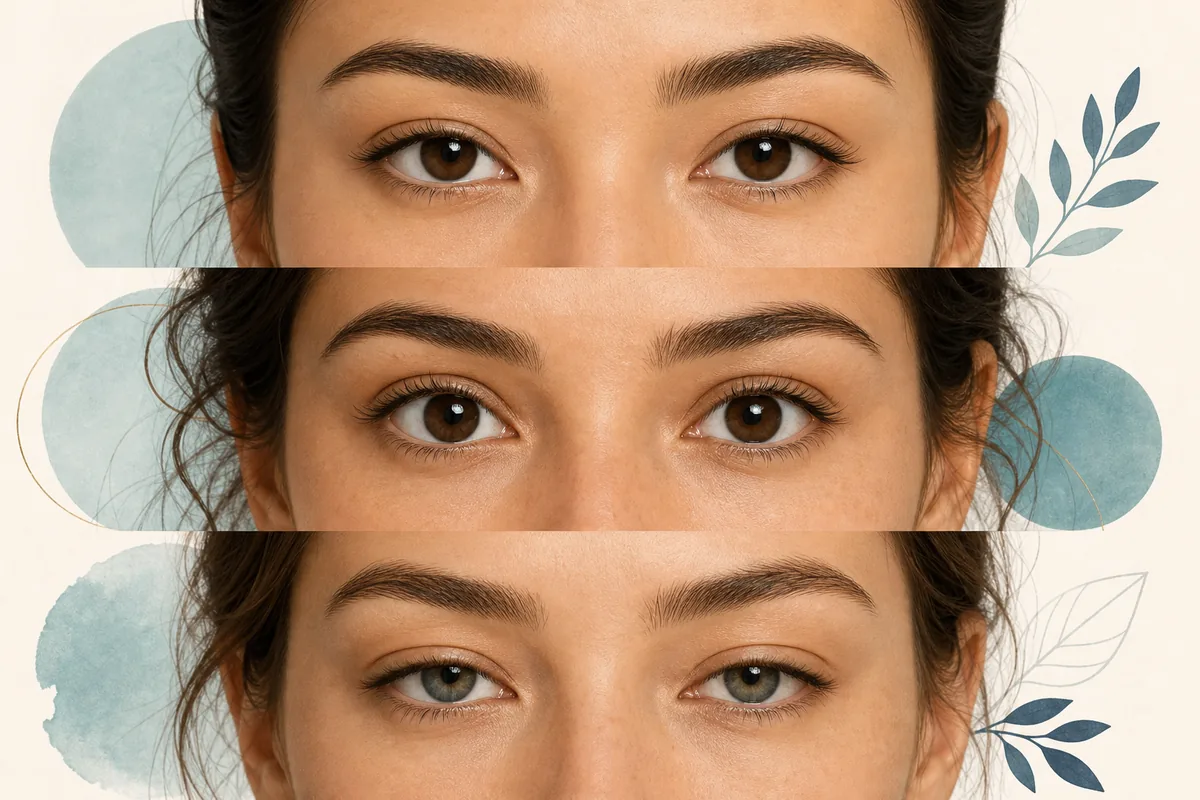
| Eye type | What to look for | Often confused with | Quick tip |
|---|---|---|---|
| Almond | The iris touches the upper and lower lids, and the eye opening looks softly tapered at both corners. | Round eyes, especially when the eyes are wide open in photos. | Relax your face before checking. Almond eyes look more elongated when the expression is neutral. |
| Round | More of the iris is visible, and you may see white above or below it when looking straight ahead. | Almond eyes in bright, surprised, or lifted expressions. | If the eye looks more circular than horizontal, round is often the better fit. |
| Hooded | A crease exists, but the upper lid skin folds over it so less lid space shows. | Monolids or simply deep-set eyes. | Open your eyes normally, not very wide. Hooding is easiest to spot in a relaxed expression. |
| Monolid | There is little to no visible crease, and the lid appears smoother from lash line upward. | Hooded eyes, especially when photos are blurry. | The key difference is crease visibility, not beauty trends or makeup style. |
| Upturned | The outer corner sits slightly higher than the inner corner. | Almond eyes or lifted makeup effects. | Draw an imaginary horizontal line through the inner corner and compare the outer edge. |
| Downturned | The outer corner sits slightly lower than the inner corner. | Hooded eyes or tired expressions in photos. | Check several images, because a chin-down angle can exaggerate the downward effect. |
| Close-set | The eyes appear closer together than one eye width. | Narrow bridge proportions or makeup placement. | Measure visually from inner corner to inner corner, then compare that gap with one eye width. |
| Wide-set | The space between the eyes appears wider than one eye width. | A strong nose bridge or a very open face shape. | Spacing is not the same as lid type, so treat it as a separate trait if needed. |
Note: close-set and wide-set are often described as spacing traits rather than stand-alone shape categories. In practice, beauty guides still include them because readers search for them the same way they search for almond or hooded eyes.
How to check your eye shape without overthinking it
There is a sweet spot between guessing from one random selfie and turning the whole process into a detective novel. The best method is surprisingly low-tech: use a straight-on photo, keep your expression relaxed, and study one feature at a time.
If your result feels ambiguous, that is normal. Lighting, eyeliner, lashes, camera angle, and even smiling can change how your eyes appear. That is why a calm, repeatable process matters more than one dramatic image.
Start with a neutral photo
Choose a front-facing photo taken at eye level in soft, even light. Avoid heavily angled selfies, exaggerated expressions, or strong beauty filters. The cleaner the reference image, the easier the shape check becomes.
- Keep your head straight rather than tilted.
- Use a relaxed face instead of a wide smile or raised brows.
- If you wear liner or lashes, compare with a makeup-free photo too.
Look for crease visibility first
Before deciding whether your eyes are almond or round, start with the upper lid. Can you clearly see a crease? Is it partly hidden? Or does the upper lid look smooth without a visible fold? This first observation separates monolid and hooded discussions from the rest.
- Little to no crease usually points toward a monolid.
- A hidden crease with extra skin folding over it often points toward hooded eyes.
- A visible crease does not automatically tell you the full shape, so keep going.
Study the outline of the eye opening
Now shift your focus from the lid to the actual opening of the eye. Does it look longer and more tapered, or more open and circular? This is the easiest way to start separating almond eyes from round eyes.
- Almond eyes usually look longer than they are tall.
- Round eyes usually show more vertical openness.
- If the iris touches both lids without much white showing, almond is often more likely.
Check the corner angle
Next, compare the inner and outer corners. This is the feature behind upturned and downturned labels. In beauty language it is simple; in anatomy-adjacent language, it relates to the tilt of the eye corners.
- If the outer corner lifts slightly higher, the eyes read as upturned.
- If the outer corner sits slightly lower, the eyes read as downturned.
- Repeat this check across multiple photos because camera angle can fool you.
Check spacing last
Finally, decide whether spacing is part of the picture. Many people have a primary lid or outline shape plus a spacing trait. That is why a person may accurately describe their eyes as almond and close-set, or hooded and wide-set.
- A gap smaller than one eye width suggests close-set eyes.
- A gap larger than one eye width suggests wide-set eyes.
- Spacing is useful for makeup placement and styling, even when your main shape label is something else.
8 eye types explained in plain English
The easiest way to make an eye shape chart useful is to describe each type in everyday language, then pair it with the specific details readers should actually look for. Below, each section explains the visual feel of the shape, the markers that matter most, and the mix-up that happens most often.
Think of these descriptions as a comparison guide, not a beauty ranking. No eye shape is a gold medal and no eye shape is a problem to fix. What changes from type to type is simply the architecture of the lid, the openness of the eye, or the spacing across the face.
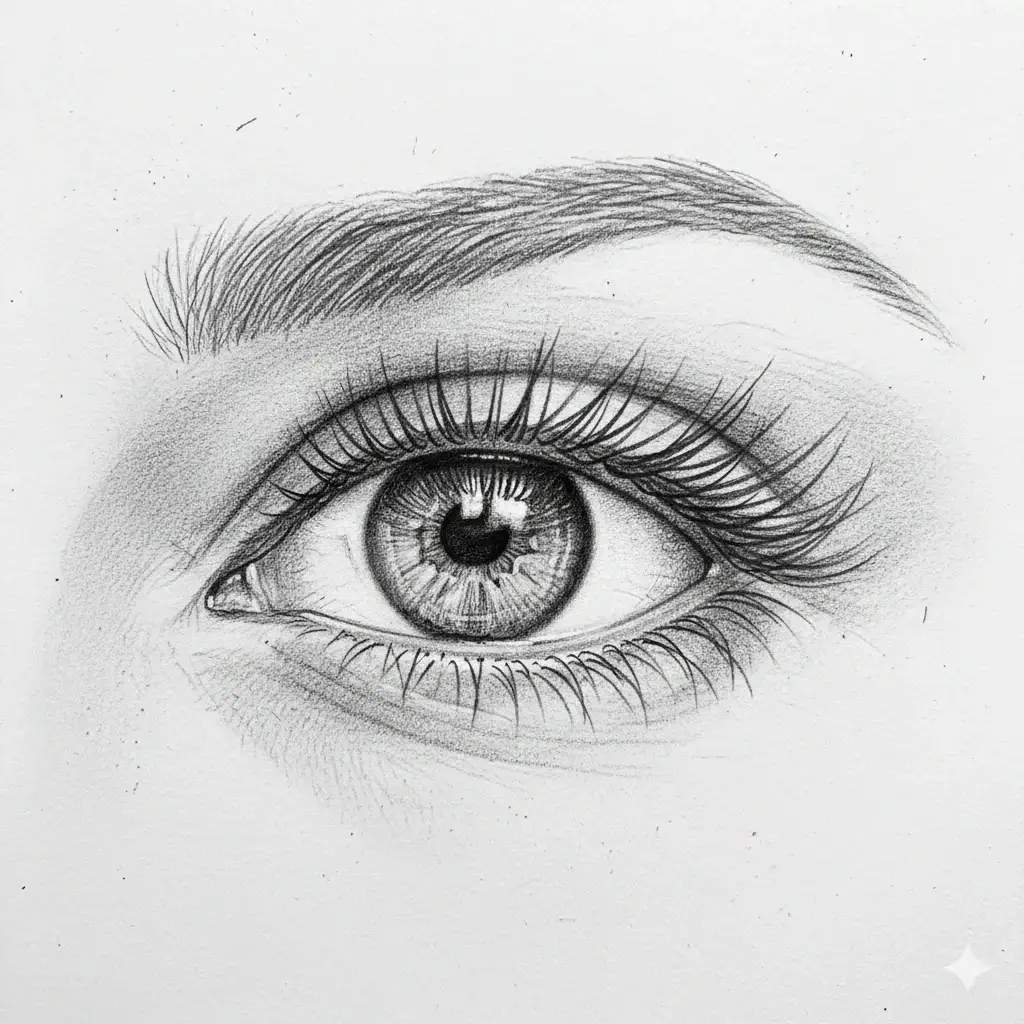
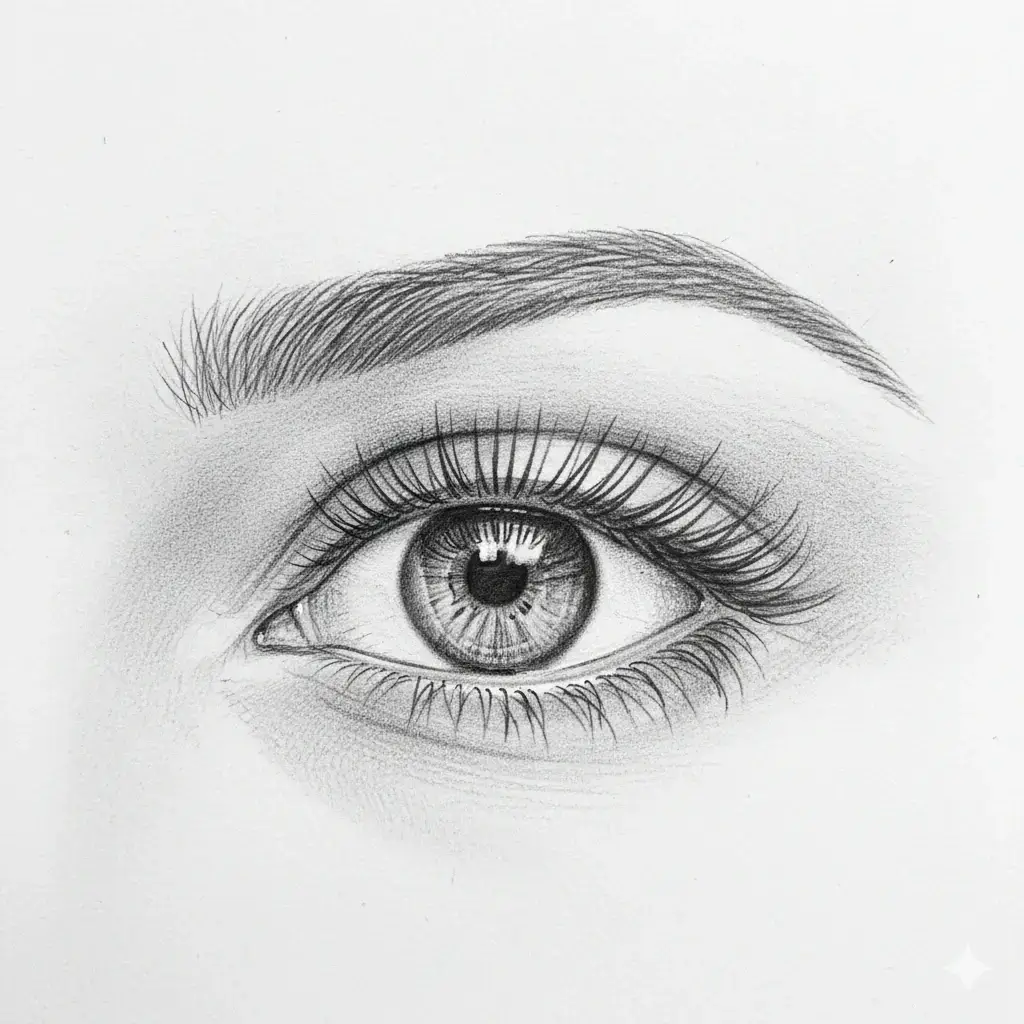
Almond eyes
Almond eyes are often described as balanced because the eye opening looks gently elongated rather than very round or very narrow. The iris usually touches the top and bottom lids, and the outer corners taper softly instead of ending in a blunt circle. In everyday terms, almond eyes often feel elegant and streamlined, even without makeup.
People with almond eyes frequently think they have round eyes when they are smiling or opening their eyes wide in selfies. That is understandable, because expression changes the vertical openness of the eye. A relaxed photo usually reveals the true shape more clearly. Almond eyes can also overlap with hooded, upturned, or downturned traits, which is why one label does not always tell the full story.
Look for
- A longer, slightly tapered opening rather than a very circular one.
- The iris touches or nearly touches both the upper and lower lids.
- A smooth contour from inner to outer corner.
Common confusion
Almond eyes are most often confused with round eyes when the eyes are opened wide or emphasized with brightening makeup.
Round eyes
Round eyes tend to look more open vertically, so they often create a bright, alert, expressive impression. When someone asks why their eyes look larger in photos, roundness is often part of the answer. The visible shape can feel more circular or doll-like, especially when the iris is clearly framed and more white of the eye shows around it.
Because round eyes photograph vividly, they are one of the easiest shapes to spot and one of the easiest shapes to misread. Strong eyeliner, upward lashes, or a slightly lowered chin can pull them closer to almond in some images. The most useful test is to look at how circular the eye still feels when the face is calm and the image is straight on.
Look for
- A more open, circular impression than almond eyes.
- Visible sclera above or below the iris in some neutral photos.
- A taller eye opening rather than a stretched horizontal one.
Common confusion
Round eyes are often mistaken for almond eyes after eyeliner, lash curls, or photo angles visually lengthen the eye.
Hooded eyes
Hooded eyes have a crease, but less of the upper lid remains visible when the eyes are open because the skin folds over part of the crease. The effect can be subtle or pronounced. Some hooded eyes still show a visible fold, while others reveal only a narrow ribbon of lid space above the lashes.
This matters because hooding is not the same thing as one specific outline shape. A person can have hooded almond eyes, hooded round eyes, or hooded eyes that are slightly upturned. Beauty tutorials sometimes treat hooding as a category that replaces everything else, but it works better as a lid trait that can coexist with other eye shape features.
Look for
- A visible crease that becomes partly hidden when the eyes open.
- Less exposed lid space between the lashes and the crease.
- A fold of skin that sits over the upper lid.
Common confusion
Hooded eyes are most often confused with monolids, even though monolids typically have little or no visible crease.
Monolid eyes
Monolid eyes typically show little to no visible crease when the eyes are open, giving the upper lid a smoother appearance from lash line upward. The shape is common in many East Asian populations, but monolids are not limited to one ethnicity and can appear in a range of facial structures.
The practical point is simple: monolid is mainly about crease structure, not about whether the eye is beautiful, sleepy, dramatic, or plain. A monolid can still be almond, softly round, slightly upturned, or combined with close-set or wide-set spacing. Once you separate crease structure from overall eye opening, the chart becomes much easier to use.
Look for
- Little or no visible fold above the lashes in a neutral expression.
- A smoother upper lid plane compared with a typical visible crease.
- A shape that may still read as almond or round in outline.
Common confusion
Monolids are often mislabeled as hooded eyes when the distinction really comes down to whether a crease is visible.
Upturned eyes
Upturned eyes have outer corners that sit slightly higher than the inner corners. In photos, this creates a naturally lifted finish that many people associate with cat-eye makeup even before any liner is applied. The lift can be delicate rather than dramatic, so you do not need a sharp angle for the label to fit.
This trait is easiest to assess when the face is level with the camera. Tilted selfies, chin lifts, or heavy winged liner can exaggerate the effect and make nearly any eye look more upturned than it is. When in doubt, compare several plain photos and focus on the natural line of the eye opening rather than the makeup.
Look for
- Outer corners sitting subtly higher than inner corners.
- A lifted impression even with minimal makeup.
- A shape that may overlap with almond or hooded traits.
Common confusion
Upturned eyes are often confused with almond eyes because many almond eyes also have a gentle upward pull at the corners.
Downturned eyes
Downturned eyes have outer corners that sit slightly lower than the inner corners, giving the eye a softer, gentler descent toward the outside edge. In some faces this reads sweet and delicate; in others it simply reads calm. Either way, the distinguishing feature is the outer corner angle, not the amount of lid space.
People often misread downturned eyes when they are tired, smiling heavily, or shooting from above. A high camera position can pull the outer corners lower in a photo. That is why you should confirm downturned eyes across multiple images, ideally with one straight-on portrait and one mirror check in natural daylight.
Look for
- Outer corners sitting slightly lower than inner corners.
- A gentle downward sweep near the outer edge.
- A soft rather than sharply lifted finish.
Common confusion
Downturned eyes are often mistaken for hooded eyes because both can create a softer outer-eye appearance in certain photos.
Close-set eyes
Close-set eyes describe spacing more than lid structure. The inner corners sit relatively closer together, often measuring visually at less than one eye width apart. This does not tell you whether your eyes are hooded, almond, or round. It simply adds another piece of the puzzle, one that is especially useful for makeup placement and frame choice.
Spacing traits deserve their own attention because many people sense something distinctive about their eyes but cannot place it. They search for a shape term when the real answer is about proportion across the face. Once they realize they have almond eyes that are close-set, or hooded eyes that are close-set, their features suddenly make more visual sense.
Look for
- A narrower gap between the inner corners than one eye width.
- Features that feel visually concentrated toward the center of the face.
- A need to evaluate spacing separately from crease and outline.
Common confusion
Close-set eyes are often confused with narrow eyes, even though the issue is distance between the eyes rather than the shape of each eye opening.
Wide-set eyes
Wide-set eyes also describe spacing rather than crease structure. The distance between the inner corners appears larger than one eye width, which can create an open, airy look across the upper face. Again, this trait can sit on top of other shape categories, so someone may correctly describe themselves as round and wide-set or monolid and wide-set.
Wide-set eyes are useful to identify because they affect balance decisions in makeup, brow styling, and glasses selection. They are not a flaw to correct; they are simply a proportion to understand. Once readers know the difference between spacing and outline shape, they usually become much more confident about using eye shape charts.
Look for
- A gap between the inner corners that appears larger than one eye width.
- An open sense of space across the eye area.
- A spacing trait that should be combined with another main shape label.
Common confusion
Wide-set eyes are often confused with large eyes, even though one describes spacing and the other describes perceived size.
The mix-ups people make most often
If you have ever searched for your eye shape and ended up with three tabs, four contradicting answers, and a slight desire to throw your phone across the room, this section is for you. The same pairs come up again and again because they share one visual trait while differing in another.
When you compare eye shapes, always ask one disciplined question at a time. Are you checking crease visibility? The eye opening? The corner angle? Or the spacing between the eyes? Separating those layers is the fastest way to stop confusing one category with another.
This is the classic confusion. Both can look bright and attractive in photos, and both can appear larger or narrower depending on expression. The real difference is the overall outline. Almond eyes usually feel longer and more tapered, while round eyes feel more open vertically and more circular overall.
A simple test is to look at the iris in a straight-ahead photo. If the iris is framed by the top and bottom lids with little white showing, almond is often more accurate. If you can clearly see more white around the iris in a calm expression, round may be the better fit.
- Ask whether the eye feels elongated or circular first.
- Ignore exaggerated mascara or bright-eye makeup when judging.
- Compare at least two neutral photos before choosing.
This pair causes more confusion than any other, especially in screenshots or blurry selfies. Hooded eyes do have a crease, but the fold of skin covers part of it when the eyes are open. Monolids usually show little or no visible crease at all. Once you understand that difference, the labels become much less slippery.
It also helps to remember that hooding can coexist with other shapes. A person can have hooded almond eyes, which is why trying to force hooded eyes into a separate universe from other eye shapes usually creates more confusion, not less.
- Visible but covered crease suggests hooded eyes.
- Little to no crease suggests monolids.
- Do not use eyeliner style as evidence because makeup can fake both effects.
The easiest way to compare these is to imagine a line running from the inner corner outward. If the outer corner sits higher, the eye reads as upturned. If it sits lower, it reads as downturned. In anatomy-adjacent terms, this relates to eye-corner tilt, but in practical beauty language, it is just about where the outer edge finishes.
Be careful with selfies taken from above or below. Camera angle changes corner perception fast. A straight-on image is much more reliable than the dramatic beauty angles we all secretly prefer.
- Use a front-facing image for the most honest comparison.
- Judge the natural eye line, not the eyeliner wing.
- Repeat the check across several photos if the result feels close.
People often use these terms as if they mean the same thing, but they describe different visual ideas. Close-set eyes refer to spacing between the eyes. Narrow eyes usually describe the shape or perceived openness of each individual eye.
You can absolutely have eyes that are close-set and round, or wide-set and narrow, because spacing and shape are not mutually exclusive. Once that clicks, eye shape charts feel far more logical.
- Measure the gap between the inner corners for spacing.
- Measure the openness of each eye for narrowness or roundness.
- Treat spacing as a companion trait rather than a replacement label.
Mirror check vs AI analysis: when each one helps
A mirror or selfie check is a wonderful starting point because it trains your own eye. You begin noticing crease visibility, spacing, and corner angle in a way that feels intuitive rather than mysterious. That self-awareness is valuable on its own, especially if you mostly want help with makeup, lashes, or glasses.
An AI eye shape detector becomes useful when your features overlap or your photos keep giving you mixed signals. Maybe your eyes are almond but slightly hooded, or round but a touch downturned. In those in-between cases, an analysis tool can help you compare patterns more consistently across photos, provided the image is clear and front-facing.
The healthiest approach is to combine both. Use a chart to understand the terms, use your own photo judgment to narrow the field, and then use an AI tool as a confirmation step rather than a replacement for common sense. That approach aligns with good E-E-A-T practice too: be transparent about method, admit ambiguity where it exists, and avoid pretending the result is medical truth.
| Method | Best for | Strength | Limit |
|---|---|---|---|
| Mirror check | Learning the vocabulary of eye shape and building your own visual confidence. | Immediate, free, and good for checking crease visibility and spacing. | Easy to misread when lighting or expression changes. |
| Single selfie | Quick comparison with an eye shape chart. | Convenient and easy to save for side-by-side review. | Angles, filters, and camera distortion can distort shape cues. |
| AI detector | Borderline cases and repeated comparison across multiple photos. | Consistent pattern recognition when the input image is clean. | Still depends on image quality and should not be treated as a medical authority. |
Why eye shape matters for makeup, lashes, and glasses
People rarely search for an eye shape chart out of pure academic curiosity. Usually there is a practical question hiding underneath: why does one eyeliner trick work beautifully on someone else and disappear on me? Why do certain lash styles look heavy on my face? Why do some glasses make my eyes feel closer together or farther apart?
That is where eye shape knowledge becomes genuinely useful. Not because you need rules, but because you gain language for what your features are already doing. Once you understand whether your main concern is lid space, corner angle, or spacing, beauty choices become less random and much more personal.
Makeup notes
- Hooded eyes often benefit from placing shape slightly above the natural fold so details stay visible.
- Round eyes often look beautifully balanced with liner that adds horizontal length.
- Downturned eyes often suit lift-focused placement near the outer third.
- Close-set eyes often benefit from brighter inner corners and less darkness packed near the tear duct.
Glasses and lash notes
- Wide-set eyes often look balanced with frames that draw attention inward through bridge or brow detail.
- Almond eyes tend to handle many frame and lash shapes well because the proportions are versatile.
- Monolids often benefit from curl and definition choices that add visibility without overwhelming the lid.
- Very dramatic wings or flares can visually change your perceived shape, so always check your natural eye first.
How this article follows quality and trust standards
Google's E-E-A-T principles reward content that is genuinely helpful, transparent about its method, and grounded in reliable information. For a beauty-identification article like this one, that means doing more than tossing around trendy labels. It means separating observation from hype, acknowledging overlap between categories, and making it clear where anatomy language supports the explanation.
We also avoid a trap that weak eye-shape content often falls into: pretending every face belongs to one rigid box. Real faces are layered. Someone can have hooded almond eyes that are slightly close-set. Someone else can have monolid eyes with a softly upturned line. Good guidance should make readers feel more informed, not less.
- We explain categories in plain English and note where overlap is normal.
- We distinguish shape, lid structure, and spacing instead of blending them carelessly.
- We cite one general reference and one mainstream educational source in the references below.
- We state clearly that this is an educational beauty guide, not a medical diagnosis.
Frequently asked questions
That usually means you are noticing more than one valid trait, which is completely normal. A person can have almond eyes that are hooded, or monolid eyes that are slightly upturned, or round eyes that are wide-set.
When that happens, choose one main label for the outline or lid structure and one supporting label for spacing or angle. That gives you a much more useful description than forcing everything into one word.
No. Hooded eyes usually have a crease, but part of it is covered by the upper lid skin when the eyes are open. Monolids usually show little to no visible crease.
The confusion happens because both can reduce visible lid space, especially in photos. Crease visibility is the clearest distinction.
Check the overall outline in a neutral, straight-on photo. Almond eyes look more elongated and tapered, while round eyes look more open vertically and more circular.
If the iris touches the top and bottom lids with little white visible, almond is often the better fit. If you can see more white around the iris in a calm expression, round may be more accurate.
You can have more than one eye-shape trait, yes. Most people do. That is why descriptions like hooded almond eyes or round, close-set eyes are completely reasonable.
The trick is to avoid mixing different types of labels by accident. Lid structure, outline shape, corner angle, and spacing all describe different aspects of the eye area.
Strictly speaking, many experts would call those spacing traits rather than pure eye shapes. But they remain useful and widely searched because spacing changes how the eye area is perceived.
For readers, the practical takeaway is simple: keep the term if it helps describe your features, just remember it is probably complementing another main shape label.
Not completely. A good chart teaches you what the categories mean and what visual cues matter. That understanding helps you judge whether an AI result makes sense.
An AI detector works best as a confirmation tool after you have done a basic self-check, especially when your features seem to overlap.